Business of Making

From Hobby to Business · 164 pages

Everything I wish someone had handed me at the kitchen table.

You already know how to make the thing. This is the other half: deciding whether it should be a business at all, what to charge, the legal bits, launching, boundaries and growing, in the order you'll meet them. Written by a maker and business owner. Me. Each decision gets made on purpose, not found out the hard way.

Launch price $69, usually $99. A PDF download, yours to keep.

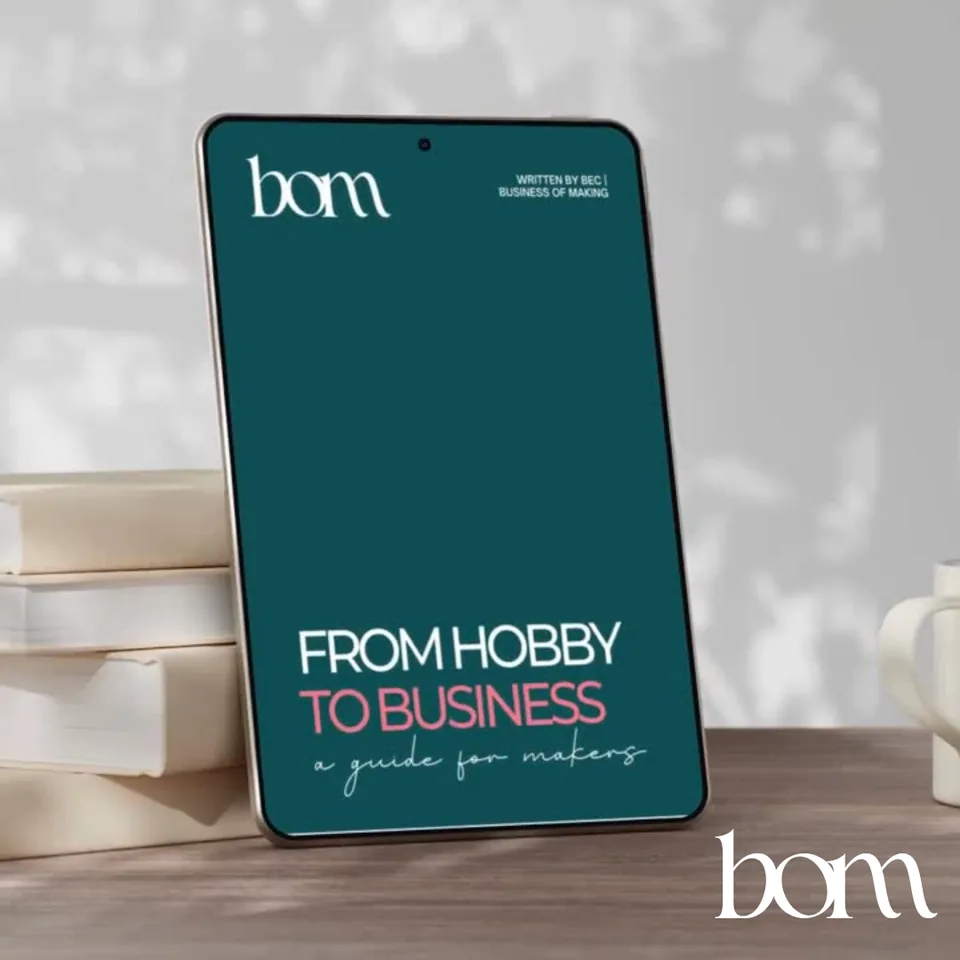
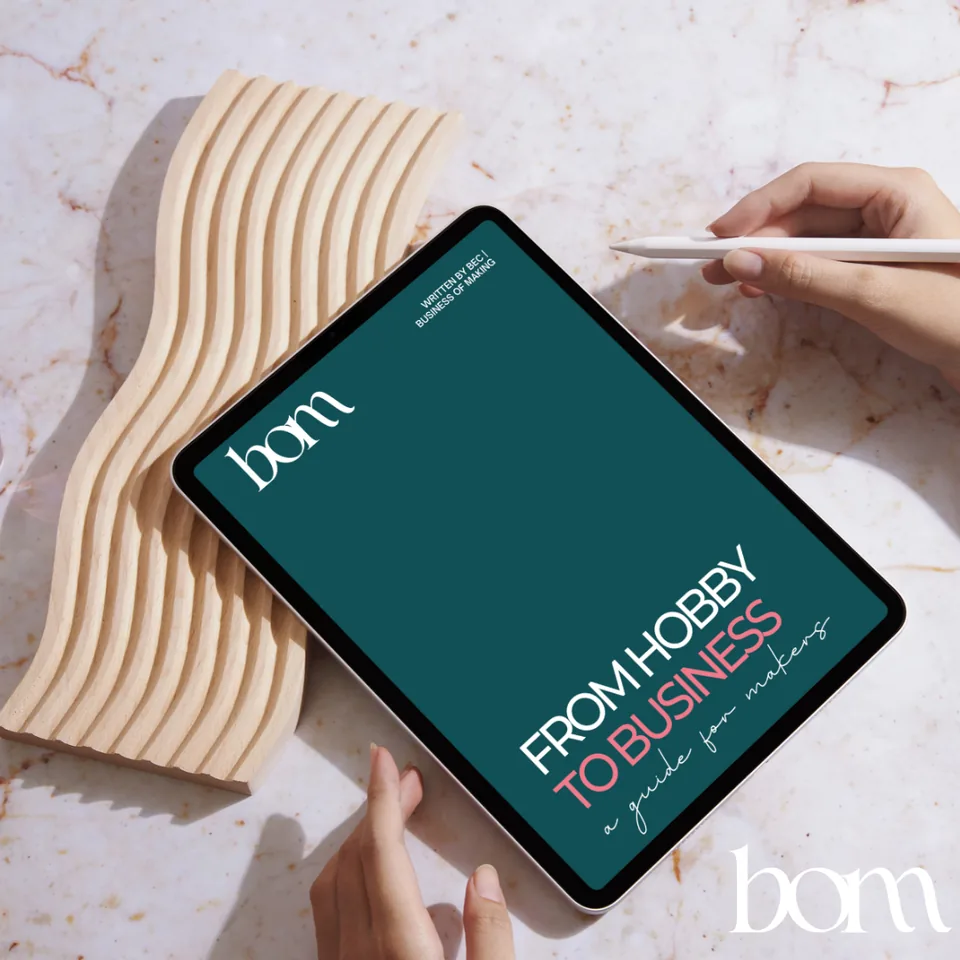
From Hobby to Business: A Practical Guide for Makers, open on a tablet

People keep telling you that you should sell it.

Maybe you already do, at the odd market or to friends of friends, and you're wondering if it could be more. Maybe you've got a name in your head and no idea what comes after the name. Either way, the questions pile up fast. What do I charge? Do I need an ABN? What happens when a parcel arrives broken? Can I say no to a friend who wants mates rates?

Here's what I've noticed. Some makers have been working for free for years without realising. Not because they're bad at business. Because no one told them to write it down. Being good at making something and being good at the business around it are two different skills, and the second one can be learnt, one small decision at a time.

This book isn't about my business. It's about yours. I've taken everything I've learnt from running Laser Blanks and Happy Print Hub, and all of the other businesses I've worked with over the past decade, and put it in the order you'll need it.

You won't walk it alone, either. Two makers go the whole way with you. Sarah crochets and wants to keep it a hobby, with the odd piece at the school fete. Emma sews zip pouches and library bags, has two kids and a 9 to 5, and wants to earn enough from her sewing to drop two days at work within a year. They're made up, but I bet you know them. You might even be one of them.

Both roads are good. Neither one is the lesser choice.

There's an expensive way to learn all this. I took it.

There's an old story about a man who started building a tower without working out what it would cost. He laid the foundations, ran out of money halfway, and everyone who walked past had a good laugh at the half-finished tower. I think about that story a lot, because I've watched so many makers do exactly that. They order the fancy packaging, buy the new machine, book the markets, and three months later they're tired, out of pocket and wondering what went wrong.

Most of the trouble I've seen makers get into wasn't because they were dodgy. It was because nobody told them. They put “no refunds” on their website because they thought they were allowed to. They added everyone who ever bought from them to their email list. They let customers collect from home, and ended up with a stranger at the door at 8am on a Saturday. All innocent, and all things that come back to bite.

I learnt most of it the way you learn when there's no one to ask: by living through it, over seven years, six lasers and 35,000 customers. You don't have to. Everything I'd tell you across the kitchen table is in here, in the order you'll need it, and you can read it in a few evenings.

Nobody handed me this. So I wrote it.

Most of the worry about starting comes from not knowing.

Planning isn't the exciting part. I know you want to get making and selling. A few evenings of planning is also where a lot of the fear goes, though. Once it's on paper, it stops being a big scary cloud and becomes a list of things you can actually do.

The same goes for the doubts. Who am I to sell this? What if no one buys? What if I can't keep up? Some of those thoughts are just fear, and they need encouragement. Others are useful concerns, and they need a plan. “What if no one buys?” might be a sign to start with a small batch before you spend thousands on stock. The book helps you tell the two apart, then hands you the plan.

The numbers you avoid looking at don't go away either. They sit in the back of your mind, quietly nagging, making every decision feel heavier. The moment you write it all down, something shifts. The worry has somewhere to go. You stop guessing and start knowing.

Knowing, even when the news isn't great, is so much lighter than wondering.

Six parts, in the order you'll need them.

Every chapter ends with a have-a-think page and a Before-you-move-on checklist, so you leave each one with decisions made, not just notes.

  1. 01

    The spark

    Hobby or business? Hot, cold, lukewarm or intentionally exploring, and why drifting is the only wrong answer. Your why, and how to use it to make decisions. Aim, then plan, then go after it, with a page for when your head gets loud. Then the part most people skip: building the business around your life. Your non-negotiables, your ideal week, and the 8am Saturday knock that taught me to keep my front door private.

  2. 02

    Planning it out

    Count the cost before you build. What you'll make (three to five products is plenty, and four questions to run each one through), start with the box, and where you'll sell: markets, Etsy or your own website, honestly compared. Pricing that covers your materials, packaging, time, running costs, fees and profit, worked through on a $44.95 cake topper and Emma's $39 pouch. What it costs to start, what your time is worth, working backwards from an income goal, what to do when things don't go to plan, and your whole plan on one page.

  3. 03

    Making it official

    Naming and claiming: the checks to run before you fall in love with a name, business names versus trade marks, your web address and handles, and locking every login down. Talk to an accountant first, with the questions to take with you. Getting set up: a proper email, getting paid, a separate bank account, and why dependable is professional. The money talk: write it all down, sales aren't profit, what to keep track of and how. The legal bits, shorter and kinder than you think: your customers' rights, product safety, other people's designs, privacy and emails, your policies, running a business from home and GST. Insurance, with the covers to ask about, and Emma calls a broker. Then finding your customers.

  4. 04

    Launching

    Markets, Etsy and Shopify, each with what it really costs and what it's good for. Building your home online: photos and listings that sell, shipping and a test run, and why your email list is gold. Running markets and online together without doubling your work. Then your soft launch, the first stranger sale, and listening and adjusting once real customers start telling you things.

  5. 05

    Setting up to last

    Running it well: make it the same way every time, the check before anything goes in the post, when the orders flood in, saying “not right now”, and putting it right when things go wrong. Then the chapter I'd underline twice: boundaries. The 9:30pm phone call, choosing how people can reach you, messages at all hours, your hours out loud, saying no, “while you're at it”, friends and family, the hardest person of all (you), when people push, knowing when enough is enough, and writing your boundaries on one page.

  6. 06

    Growing

    Being found, using the plain words your customers really type. Let your customers grow it for you, the power of reviews, and keeping them honest. Know your numbers before you grow, growing at your pace, and looking after the maker. Then a year later, where we find out how Sarah and Emma are going, one last thing from me, and the full From Hobby to Business checklist, in order, with a date-completed line for every part.
Built so you do it, not just read it.

Short chapters, plain words, one idea at a time, and a few things done on purpose, so you finish with decisions made rather than good intentions.

Two makers to walk beside

Sarah and Emma turn up in nearly every chapter, making the same decisions you'll make, and getting some of them wrong first. It's so much easier to see your own next step when you've just watched someone like you take it.

Have a think

A page of questions at the end of every chapter, so the answers are yours and not mine. A plan you wrote yourself is one you'll actually keep. By the end you'll have a why, an aim, a plan, your prices and your boundaries on paper.

Before you move on

A short checklist closes every chapter, and the whole lot sits at the back with a date-completed line for each part. Each small thing you finish proves to yourself you're the kind of person who follows through, and the next one gets a little easier.

Real numbers

Pricing worked through on a $44.95 cake topper and a $39 pouch. What's really left from a $500 month. What “drop two days at work” means in pouches a week. Real figures, because vague advice is the kind you can't act on.

Australia first, with notes for everyone else

ABNs, ASIC, the Australian Consumer Law, GST, Australia Post and Shopify, written for here. Wherever a rule changes by country, I say so and tell you what to check locally.

Honest about what it isn't

I'm a maker who's built businesses (and sold one), not an accountant, lawyer or financial adviser. The book gives you the lay of the land, tells you plainly when it's time to ask a professional, and hands you the questions to take with you.

have a think

  • Be honest. Have you been hot, cold, lukewarm, or intentionally exploring?
  • What's one thing you've been telling yourself you need before you can begin? Is it something you genuinely need, or are you waiting because beginning feels uncomfortable?
  • What does success look like for you? Not anyone else, just you.
  • If you looked at your business money today, would you know how much you've earned and how much you've spent?

Four of the questions from the book. Answer them honestly and you've already started. There's a page like this at the end of every chapter.

A year later.

It's been a year since Emma wrote that one line across the top of a fresh page. It wasn't a straight line. There was the email that fell flat, the bunting that barely sold, the week someone undercut her by half. Each time, she went back to her numbers, her plan and her why, adjusted, and kept going.

Last month, she walked into her manager's office and asked to drop two days. Her business had been covering them for three months straight, and she wanted to be sure before she made the call. Now Mondays and Wednesdays are fully hers. This year, for the first time, she was in the front row at the school assembly instead of looking at photos on her phone at her desk. On Sundays, the sewing room door stays closed.

It's not an empire. It's not meant to be. It's the life she wrote down in her notebook, built one small, faithful step at a time. Sarah's still crocheting, still gifting most of what she makes, still protecting her favourite hour of the week. She's just as happy as Emma, in her own completely different way.

Two makers. Two roads. Both of them right for them.

Emma and Sarah are made up, remember. The decisions they make, and the order they make them in, are the real part.

What you'll have when you close it.

If you write things down as we go, you'll finish with something most makers never sit down and work out.

That's not a small thing. That's the beginning of something real.

A year from now, you could still be guessing at prices and answering messages at 10pm. Or you could have your why on the wall, your plan on one page, prices that pay you, and a Sunday that's yours. The book doesn't do that for you. It shows you how, in the order you'll need it, and then it's yours to keep.

Everything you need, from the first “can I buy one?” to a year later.

From Hobby to Business

A Practical Guide for Makers

$69Launch price · RRP $99

  • 164 pages in six parts: The spark, Planning it out, Making it official, Launching, Setting up to last and Growing
  • Sarah and Emma's stories, from the first spark to a year later
  • A have-a-think page and a Before-you-move-on checklist at the end of every chapter
  • The full From Hobby to Business checklist at the back, in order, with a date-completed line for every part
  • Worked pricing examples, and the questions to take to your accountant
  • A PDF download, yours to keep, to read on your phone, tablet or laptop

One avoided mistake pays for it. Emma's was a shipping rate that didn't cover her gift sets, caught in her test order before launch.

Checkout happens on the Business of Making store. Prices are in Australian dollars.

The guide open on a tablet, propped on a stack of books beside a mug

From a maker who's done it.

Bec, with her youngest on her hip Bec Macedon Ranges, Australia Read my story

I was a graphic designer with a creative itch my day job wasn't scratching, so I begged my husband for $10,000 for a hobby laser. Just one. That laser became Laser Blanks, Australia's largest craft blanks supplier: six industrial lasers, fifteen staff, two warehouse moves and over 35,000 customers. After seven years I sold it so I could slow down and be home with our smallest.

Everything in this book comes from those years, from Happy Print Hub, the print business Tom and I still run, and from the other businesses I've worked with over the past decade. The 8am Saturday knock, the 9:30pm phone call, the accountant who wasn't the right fit, the insurance we had underwritten for our lasers. Solid decisions, a few mistakes, and all of it tested with real money and real customers. I share that not to impress you, but so you know none of it is theory.

I wouldn't trade what I learnt. I just want you to learn it sooner, and more gently, than I did.

Questions you might have.

Who is it for?

Makers. If you make something and you're wondering whether to sell it, or you've started selling and the business side is catching up with you, it's for you. Sarah and Emma cover both ends: one keeps it a hobby, one builds a business. If you're already years in, with staff and a warehouse, parts of it will feel like revision.

I'm not in Australia. Is it still useful?

Yes. The thinking is the same anywhere. Where a chapter touches something that varies by country, like registering a business, consumer law, GST or insurance, I've written the Australian version and told you what to check where you live.

Is it business, legal or financial advice?

No. It's the lay of the land from someone who's walked it, so you know what to look into and what to ask. Where you need an accountant, a lawyer, a broker or an insurer, the book says so, and in a few places it hands you the questions to take with you.

Can't I find all this online for free?

Bits of it, scattered across blogs and Facebook groups, half of it contradicting the other half, and none of it written for makers in the order you'll meet it. That's exactly where the “no refunds” signs and the accidental email lists come from. This is the whole picture in one place, with the questions to ask, from someone who's done it. A PDF, yours to keep, for the launch price of $69.

What if I only ever want it to stay a hobby?

Then The spark is all you need, and the book says so on the checklist page. Use anything else that helps, and leave the rest with a clear conscience. Sarah keeps her crochet a hobby the whole way through, and she's just as happy as Emma.

Do I need the Complete Pricing & Profit Calculator as well?

Not to begin. The pricing chapter walks you through the method with worked examples, so you can price a product with a pen and paper. The calculator does the same sums for you, with your time and the cost per hour of running your business built in, once you're pricing more than a couple of products.

Where to from here?

If you've got something half-finished on the kitchen table and a question you keep not asking, this is the book I wrote for you. Read it in a few evenings, then pick one small first step you can finish this week, like costing one product. That's how the whole book works: one small, sensible step, then the next. There's no deadline on any of it.

Whatever you do from here, do it with all your heart. Not perfectly. Just wholeheartedly.

Bec x

Free · join the list

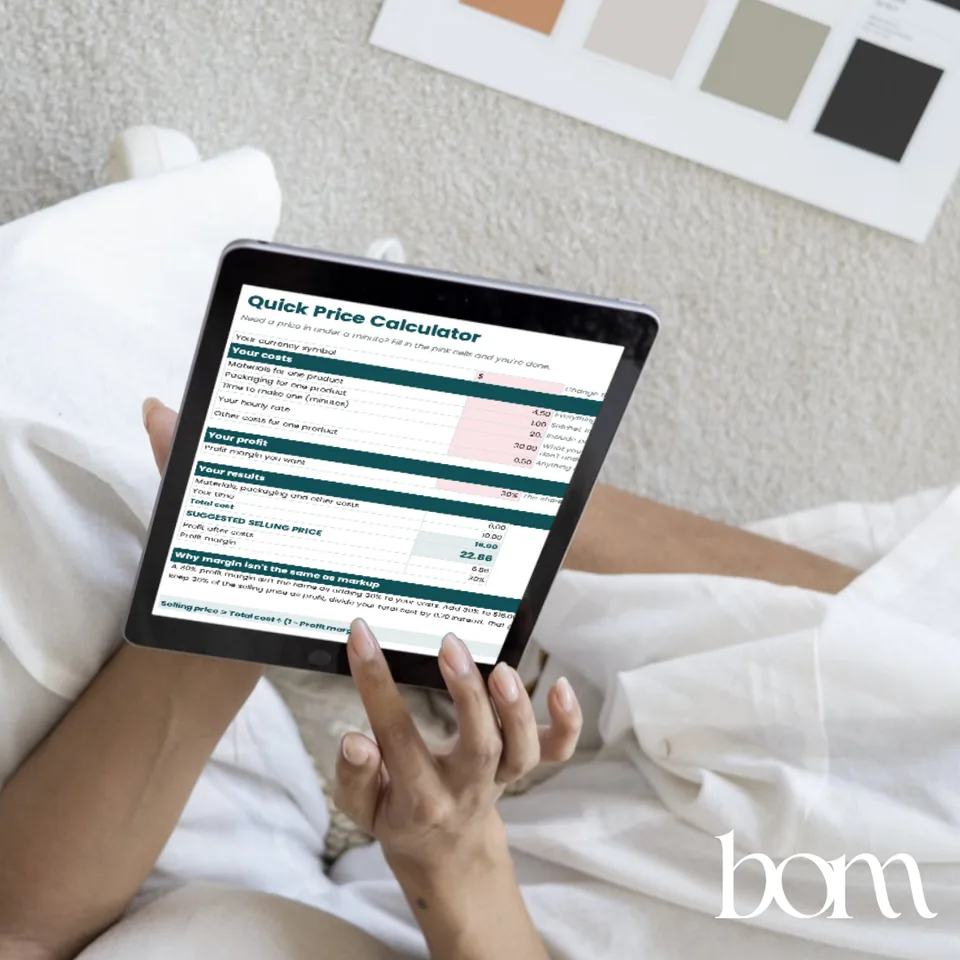
Get the free price calculator, and everything that comes next.

Pop your email in and I'll send you the Quick Price Calculator: six numbers and a price in under a minute. This is just the start. I'm building more for makers all the time, new freebies, mini courses and guides, and the list hears about every one of them first.

  • The free Quick Price Calculator, with 20% off the Complete Pricing & Profit Calculator inside
  • Every new freebie, mini course and guide, sent to you first as it's released
  • The occasional note from me, and never any spam. Unsubscribe any time.